About us

Go Back


Who is the AKE?

The Alzheimer Knowledge Exchange (AKE) is a network of people dedicated to improving the quality of life for persons with Alzheimer disease and related dementia.
The AKE promotes and supports a knowledge exchange interface amongst researchers, educators, care providers (paid and non-paid), policy makers and stakeholder organizations working in dementia-related research, policy or care.  By leveraging the knowledge and expertise of the network, we will:

  • Support learning needs of people seeking practice change for continuous quality improvement
  • Stimulate, support, and share innovations in dementia care
  • Build and strengthen collaborative partnerships between stakeholder

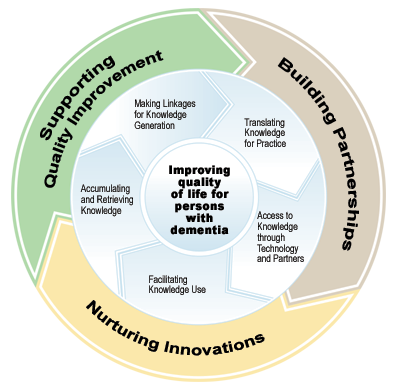
  AKE Moeel

Brochure

Why is the AKE important?

During the next decade, the number of persons with ADRD will increase by 33% (Hopkins & Hopkins, 2005).  Persons with ADRD are the largest users of long-term care homes and disproportionately high users of community services (ASO, 2007).  The AKE provides the unique service of connecting all sectors, settings, and disciplines, through informal groups, in order to improve the quality of care provided to people with dementia across the continuum of care. 

How do we provide service?

AKE facilitates knowledge exchange through:

  • Communities of Practice: Groups of people who are committed to each other to offer support, share learning, and develop new knowledge in order to advance practice on a specific topic
  • Knowledge Brokers: Support the development and nurturing of CoPs, link people to people, information or resources, and support innovation and change by leveraging the knowledge of the ADRD community
  • Library Service: Information specialists provide paid caregivers with free access to health-related evidence
    Access to Technology: Free online tools provide timely and resource-efficient support for knowledge exchange
  • Resource Centre: Contains thousands of links to people, resources, information, blogs, and discussion forums
  • Dissemination of Knowledge: Participants engage in interactive discussions and information sharing online, topics focus on practical tips, strategies, emerging trends, critical issues and best practices 

Who are our members?

The AKE helps anyone working with persons experiencing Alzheimer Disease or a related dementia.  2,500 people comprise the AKE network, these individuals include researchers, educators, care providers (paid and non-paid), policy makers, stakeholder organizations and students.

Members of the AKE benefit from access to a number of resources and tools including knowledge broker services, information specialist services, an online meeting space , an online resource centre, a password-protected collaboration space, opportunities for education and knowledge exchange, the My AKE Connection (news alerts), updates from champions in the field of ADRD.  AKE membership does not require a commitment in terms of time or resources – each member decides how and when to use the available resources to best compliment his or her daily practice.  AKE members are leveraging these tools and resources to:

  • Engage in or create topic-specific communities of practice or working groups to collaborate on specific initiatives or projects
  • Use the online meeting rooms and teleconference line to share experiences, innovations, and knowledge with others
  • Participate in education sessions lead by ADRD experts or champions
  • Answer a question or find a person or resource with the help of the knowledge broker 
  • Share upcoming events or education opportunities related to ADRD with other AKE members

People can join the AKE by completing the online registration form 

What is knowledge transfer and exchange?

Knowledge transfer is the process of moving knowledge into practice.  This process is successful when research and practice-based evidence is clear and relevant, the context shares the characteristics of a learning organization, and facilitation mechanisms are appropriate to the needs of the community of practice members (Rycroft-Malone et al., 2007).

Knowledge exchange is the mutual sharing of research and data knowledge (i.e. explicit knowledge) and/or of practice and experience based knowledge (i.e. tacit knowledge) for the purpose of improving practice. Knowledge exchange can take place face-to-face, over the telephone, or online in real-time, or it can take place by capturing and sharing stories.  The sharing of evidence via knowledge exchange is an important contributor to the success of knowledge transfer (Rycroft-Malone et al., 2007).

This knowledge transfer cycle (Sullivan et al., 2004) illustrates how the AKE is addressing the 5 non-linear phases of knowledge transfer.

  • Knowledge Generation – the AKE is committed to building reciprocal linkages between the researcher, educator, caregiver and policy maker to inform ADRD research agendas
  • Knowledge Translation – the AKE is committed to working in partnership with CoP members and relevant stakeholders to identify opportunities for knowledge translation and develop practical, evidence-based resources to facilitate the transfer of knowledge into practice 
  • Knowledge Awareness and Access – the AKE is committed to leveraging technology in order to provide researchers, educators, caregivers and policy makers with awareness of and access to relevant resources and explicit and tacit knowledge in the field of ADRD 
  • Knowledge Use – the AKE is committed to facilitating the use of knowledge (transfer of knowledge into practice) by providing knowledge exchange support and resources to CoP members and sub-CoPs 
  • Knowledge Accumulation and Retrieval – the AKE is committed to accumulating ‘stories’ from CoP members in order to build on successes and facilitate the development of new partnerships  

Learn more